Archive for March, 2009

bad science and worse

Sunday, March 29th, 2009

I’m a big fan of Ben Goldacre’s “bad science” column in the Guardian. He is particularly scathing about quackery and spurious medical science. His views of “Dr” Gillian McKeith in particular are well worth reading.

Whilst I was reading one of his columns recently, I was reminded of another “Dr” who seems to get away with hype and nonsense, one DK Matai “PhD” (though references to actually gaining the PhD are woefully thin these days), chairman of mi2g security. According to the ATCA membership page of the mi2g website:

“ATCA: The Asymmetric Threats Contingency Alliance is a philanthropic expert initiative founded in 2001 to resolve complex global challenges through collective Socratic dialogue and joint executive action to build a wisdom based global economy. Adhering to the doctrine of non-violence, ATCA addresses asymmetric threats and social opportunities arising from climate chaos and the environment; radical poverty and microfinance; geo-politics and energy; organised crime & extremism; advanced technologies — bio, info, nano, robo & AI; demographic skews and resource shortages; pandemics; financial systems and systemic risk; as well as transhumanism and ethics. Present membership of ATCA is by invitation only and has over 5,000 distinguished members from over 120 countries: including 1,000 Parliamentarians; 1,500 Chairmen and CEOs of corporations; 1,000 Heads of NGOs; 750 Directors at Academic Centres of Excellence; 500 Inventors and Original thinkers; as well as 250 Editors-in-Chief of major media. ”

(I think I’m meant to be impressed. Actually, I’m just baffled.)

Not surprisingly mi2g has recently jumped on the banking bandwagon and reinvented itself yet again, this time as a centre of expertise on the finance sector. Back in November 2002, el Reg posted an article about Matai which still bears reading, as does the earlier July article referring to the vmyths commentary on mi2g.

The really depressing point here is that the briefings all seem to come from members themselves. All that ATCA does is recycle the brief with the caveat: “Please note that the views presented by individual contributors are not necessarily representative of the views of ATCA, which is neutral. ATCA conducts collective Socratic dialogue on global opportunities and threats.”

This looks like a wonderfully inventive and highly lucrative variant on the blog theme. According to the ATCA membership pages of the website, I can receive 250 HTML briefings for £2,790.63 (including taxes) “as they are published”. This is the “gold” level of membership. The “bronze” level of membership (for £131.60 (including taxes)) would give me up to 10 HTML briefings “as they are published”. Perhaps readers of this blog would like to pay me similar amounts for something I may, or may not, write in future. I promise that the gold payer will get more than the bronze payer, but that is all.

(Interested readers are invited to do some simple on-line research. Try your favourite search engine with terms such as “hype” “mi2g” “myths” etc.)

the strong blue light

Sunday, March 29th, 2009

The 1TB Toshiba disk I bought a couple of weeks ago to upgrade storage on the slug has one big drawback in my view. Whilst the disk itself is fine, Toshiba have made the mistake of sticking a very intense blue LED on the front panel, presumably because they think it looks “cool”. Well it isn’t, it is just irritating. The damned thing is so bright it lights up the study when the main lights are off. Two strips of black insulating tape seem to have cured it though.

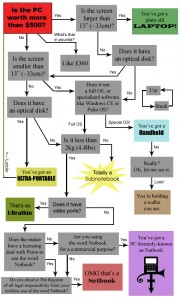
so what is a netbook?

Monday, March 16th, 2009

Having just invested in an Acer Aspire One (which I’ll write about later), I also enjoyed this FAQ from el Reg.

is it a netbook?

Nice chart.

a thirteen amp plug just won’t cut it

Monday, March 16th, 2009

I normally read the register for its IT tech related reporting – and I enjoy it just because it is a wonderfully scurrilous rag. However, an article about the Swedish supercar maker Koenigsegg’s “Quant”, which el Reg chose to call “Mary”, piqued my interest somewhat. I can’t quite make the arithmetic work out. To quote the article:

“The Mary has a top speed of 275kph (171mph), a 0-62 time of 5.2 seconds, a range of 500km (312 miles) and is powered by two electric motors pumping out a combined 512bhp (381kW) of power and 715nm (527lb ft) of torque.

While Koenigsegg is shy on exact technical details, its press release abounds with interesting ‘facts’ – including the claim that that it will be possible to charge the Mary’s NLV-developed “redox FAES (Flow Accumulator Energy Storage) to full capacity in 20 minutes and give the vehicle a range of 500 kilometres”.”

Now we if we unpick that a bit we get the following:

- the car uses 381kW of power at peak – let’s say a maximum 200kW at a sensible cruising speed of 100 kph.
- it can travel for 500 kilometers on one charge.
- it can be charged to capacity in 20 minutes.

Now 500 kilometers at 100 kph is 5 hours travel. Multiply that by 200kW and we get 1000kWh. But it can be charged in 20 minutes, so the charge rate must be three times that – i.e. 3000kWh.

No way can you get that through a 13 amp socket.

upgrading the slug – a lesson in addresses

Sunday, March 1st, 2009

My ever growing DVD collection has been taking its toll on my disk storage. Despite the fact that ripping a DVD to PSP format typically shrinks it to between 300 and 500 MB, that still means that I have over 300 GB of videos on my PC. Add to that the OGG vorbis audio collection of my ripped CDs and the usual collection of photos and other critical data that I back up to the slug and I was getting perilously close the 500 GB limit of the attached USB disk. Time for an upgrade.

ITB disks are now appearing on the market at well under £100.00. Ebuyer are currently selling 1TB Toshiba external disks for an astonishing £69.00 inc VAT, but there were none actually in stock this weekend. Fortunately I managed to source exactly the same disk from a local supplier for only a few pounds more than the ebuyer price. Times certainly are hard. I doubt that he made much of a margin on the sale. But it made me happy and he knows I’ll go back there again.

Since I originally built my slugs last year, Debian Lenny has moved from testing to stable, and the latest Debian installer from slug-firmware.net is now “Debian/NSLU2 (armel) 5.0 Stable”. For a while the installer was available in two flavours for the ARM architecture used by the slugs.. The old ARM port was called “arm”, whilst the new ARM port using the EABI (see wiki.debian.org/ArmEabiPort) is called “armel”. This port supposedly offers better support for floating point and other features. Both the arm and armel architectures are supported for Lenny (now Debian 5.0) but according to Martin Michlmayr the old arm port will be dropped after this release. So, it looks as if an OS upgrade is necessary now anyway. Unfortunately, there seems to be no easy upgrade path from arm to armel, so a reflash was in order. This took me rather longer than I had anticipated because of a stupid mistake on my part. Lesson – always document any changes you make – even on a small network……

Martin has updated his excellent installation notes to cover both the new image and the installer itself. In that note he says that the installation should take around four hours. Well mine took nearer to six because I couldn’t connect to the damned slug after reflashing with upslug2. The IP address I had previously been using on the slug wouldn’t respond at all. I tried reflashing again, then reflashing with the original Linksys image in the hope that I could then connect to the default Linksys address of 192.168.1.77 and reconfiguring from there Then reflashing again. Nothing worked.

Now, whilst my network is not overly complicated, it is segmented and I use two separate RFC1918 netblocks. I couldn’t recall using the slug on a different netblock to the one I was attempting to install on, but in a “what the hell, it’s worth a try” moment, I unhooked the slug from my internal net and stuck it on a separate switch along with a laptop to test connections. I configured the laptop with my outer net’s address and then ran nmap to scan the entire range hoping to find the slug. No joy,

At this stage I thought that I must have fritzed the slug somehow and was about to give up. But before doing so, I switched back to testing on the original network address – i.e. I reconfigured the laptop to my internal network address range and re-ran nmap. Bingo – up popped the slug. On the same IP address as my main PC on the internal net. I then remembered that I had shuffled some machines around on the internal net and moved from DHCP to static addresses (in a “rationalisation” period a few months back). I had given the slug a new fixed IP address, but had, of course, forgotten that the old IP address would be hard-wired into the slug’s flash memory . The only way you can change this hard-wired address is through the Linksys interface, which of course I was no longer using. My reflash of the slug had removed the IP address I had configured in Debian and left the old, conflicting address, in use. And no, I have no idea why I chose to use the same address for my main PC. A great way to spend a saturday afternoon. Next time, write it all down.

Martin is right though. After the wasted time, the new install took around four hours.